Wonderful Blog
LinkedIn Thought Leadership Ads

Published March 13, 2026
LinkedIn Thought Leadership Ads
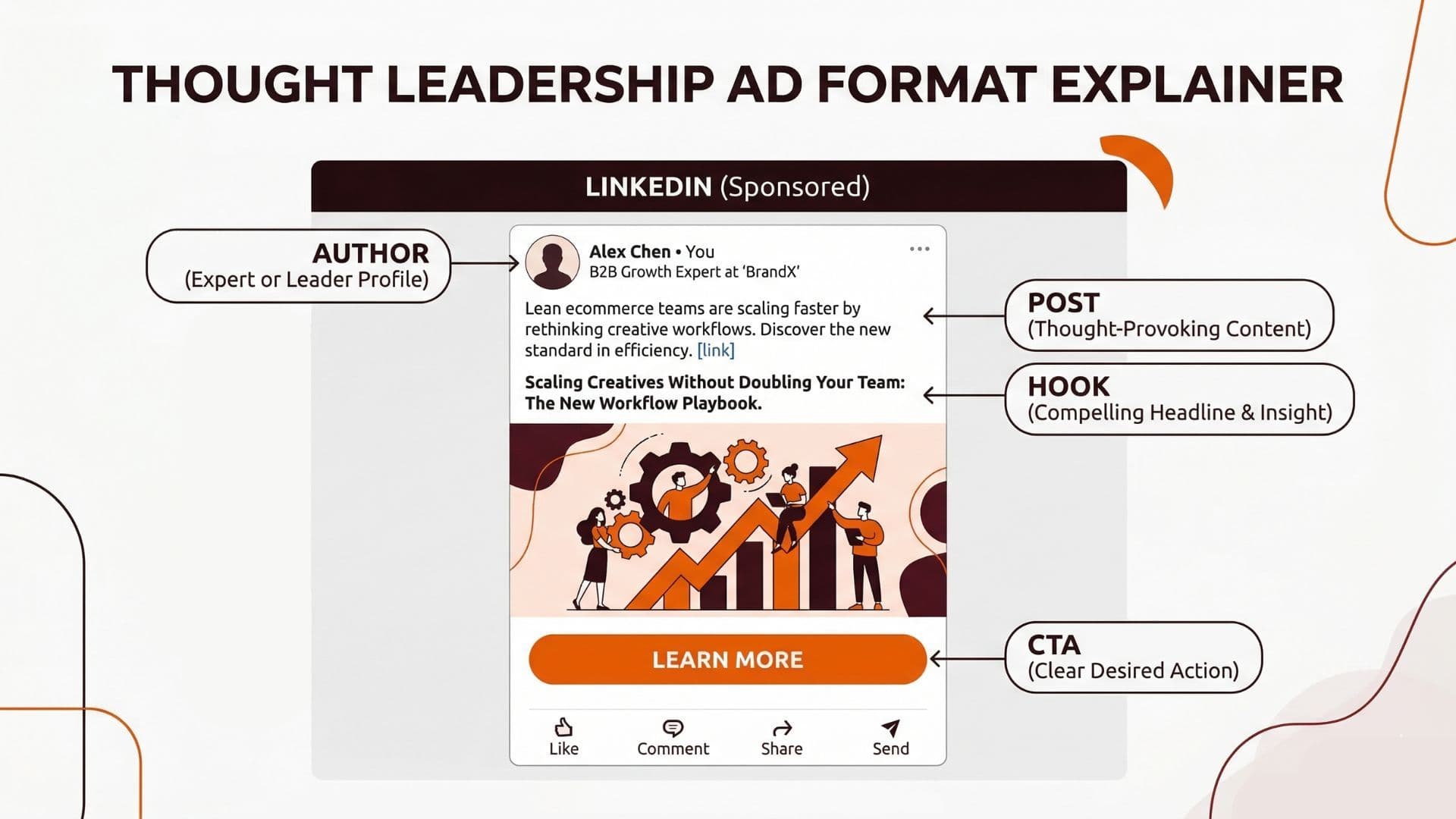
Thought leadership ads on LinkedIn are not “another ad format.” They are a format designed to carry authority: the ad needs a credible voice, a clear point of view, and content that makes the next step feel obvious.
This post focuses on the thought leadership format itself and how to decide when to use it in your B2B workflow. It is not a full LinkedIn ads spec guide and it is not a list of every ad type.
LinkedIn describes Thought Leader Ads as sponsored organic posts published by individuals on their personal profiles. That “people-first” distribution is why credibility and voice matter so much for this format. For reference: Thought Leader Ads (LinkedIn).
TL;DR
- Use thought leadership when credibility drives action. If your buyers need trust to move forward, this format can outperform generic lead-gen.
- Match the voice to the buyer. The author matters because the content is doing the work.
- Validate the creative, not just the format. Strong creative explains a point of view and gives proof; weak creative sounds generic.
- Place it in the right workflow stage. It works best in evaluation and mid-funnel situations, not as a cold “ask” without context.
What Thought Leadership Ads Are (In Practice)
In practice, thought leadership ads wrap B2B content with an authoritative voice.
Your ad should answer:
- Who is speaking (and why should the buyer trust them)?
- What is the point of view (one clear idea, not a pile of topics)?
- What does the buyer get after clicking (a next step that supports evaluation)?
If your creative does not make those answers easy, the format cannot rescue the message.
When to Use It (And When Not To)
Use thought leadership ads when:
- Your product is complex enough that buyers want expert guidance.
- You can credibly support claims with customer outcomes or implementation detail.
- You have a real author voice (founder, product leader, or recognized subject expert).
Avoid using it as a replacement for:
- Clear bottom-funnel CTAs when you have strong intent and a direct next step.
- Simple product value offers that do not need authority to convert.
If your offer is “trust me” without proof, thought leadership will just look like generic marketing.
Good vs Weak Creative (The Difference)
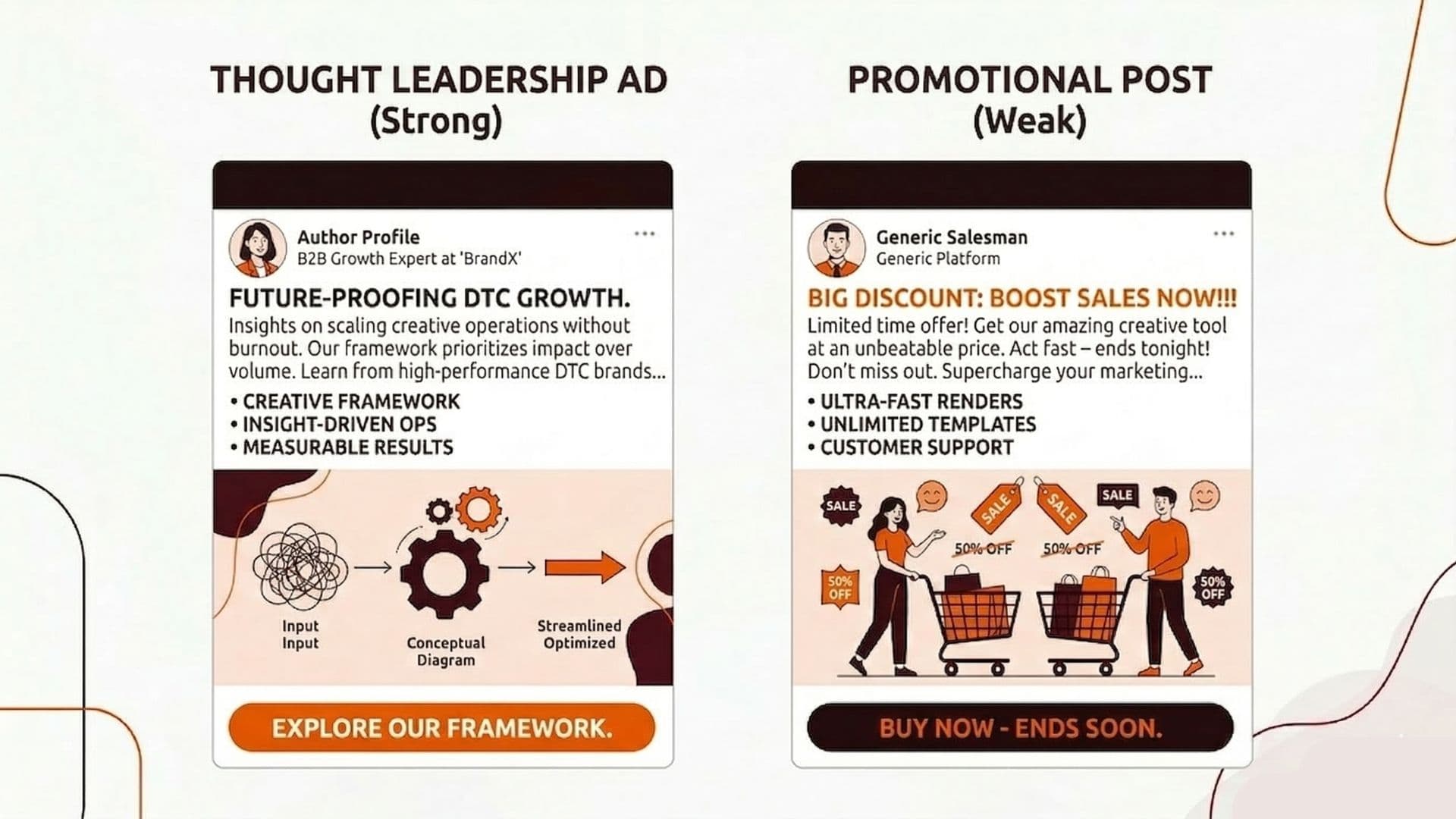
Strong thought leadership creative tends to:
- Lead with one sharp POV statement.
- Tie the POV to a practical outcome (what changes for the buyer).
- Include proof that makes the authority believable.
- Make the CTA feel like a continuation of the argument (not a random download).
Weak creative tends to:
- Cover broad topics with no point of view.
- Sound like blog summaries (“in this article we discuss…”).
- Use author names without credible context.
- Treat the CTA as a generic lead capture.
How It Fits into Your B2B Ad Workflow
A simple way to place thought leadership:
- Top funnel: educational problem framing and general credibility building.
- Mid funnel: thought leadership ads that build authority and help evaluation.
- Bottom funnel: demo/trial CTAs once the buyer trusts the message.
If you already have SaaS-specific campaign structure, you can plug thought leadership into the mid-funnel stage. For SaaS workflow background, see LinkedIn Ads for SaaS. To brief and produce thought leadership content, use our briefs product. For creative research and examples of thought leadership ad formats, see our ad library.
Actionable Takeaway
If you want LinkedIn thought leadership ads to perform:
- Pick a credible author voice.
- Write one clear POV tied to real outcomes.
- Use the format in evaluation/mid funnel where trust unlocks action.
- Validate creative quality with a good-vs-weak checklist, not just format labels.
Soft CTA
Wonderful can help keep thought leadership creative production aligned with your approval workflow so your authority content does not get delayed or revised endlessly.