Wonderful Blog
Recruiting Landing Pages

Published March 22, 2026
Recruiting Landing Pages
Recruiting landing pages work when they remove doubt quickly. Candidates want to know the role, location, level, and next step before they invest energy in an application.
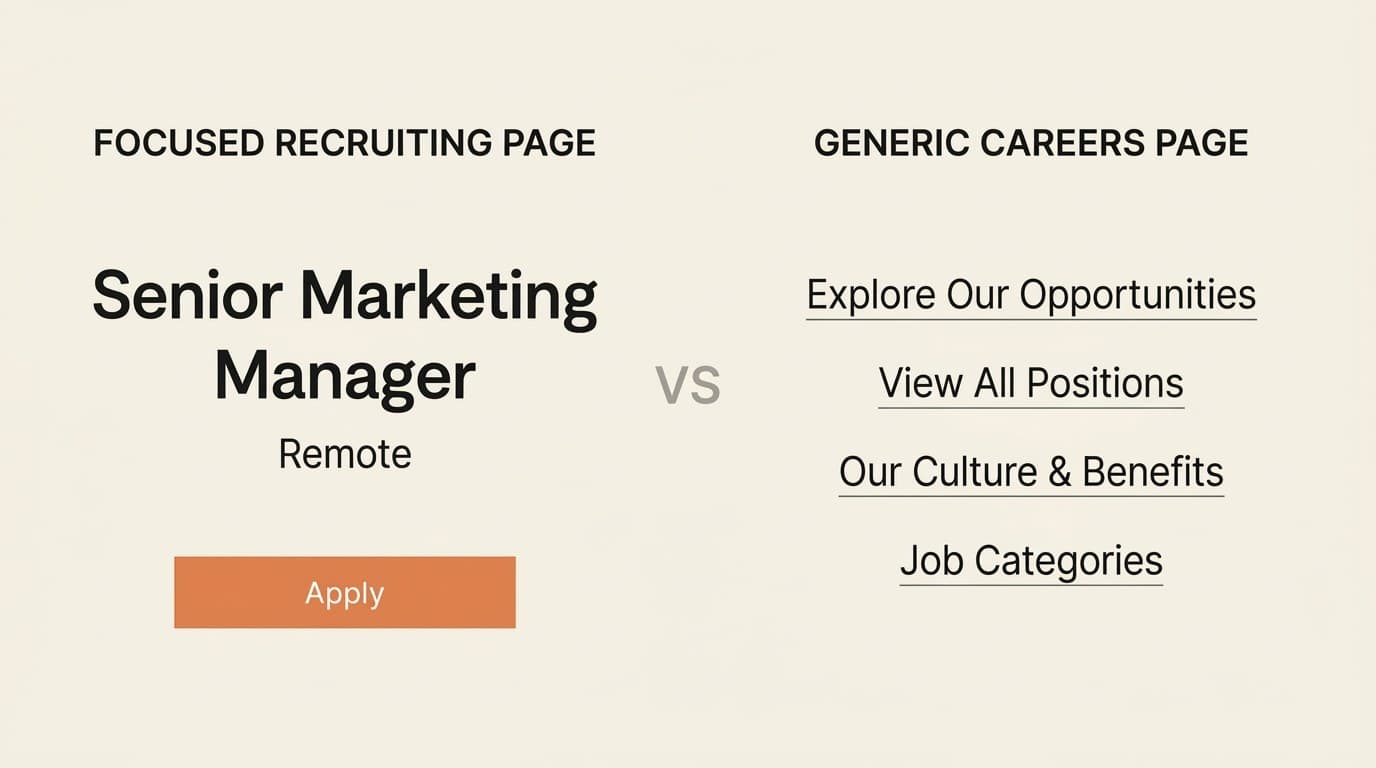
That makes recruiting pages different from general careers pages. A careers page is a directory. A recruiting landing page is a conversion page built for one role or one hiring need.
TL;DR
- Be specific immediately. Role title, location, and seniority should be visible above the fold.
- Use one clear apply CTA. Multiple competing actions weaken the page.
- Match the ad exactly. If the ad says "Senior Marketing Manager - Remote," the page should say the same thing.
- Reduce uncertainty. Team context, hiring process, and expectation-setting help serious candidates act.

Why Generic Careers Pages Underperform
Many companies send job ads to a generic careers page with:
- multiple open roles
- lots of navigation
- brand storytelling before job details
- several competing CTAs
That is useful for browsing, but weak for conversion. A candidate who clicked on one ad wants confirmation that they landed in the right place. If the page does not answer that quickly, attention drops.
Recruiting landing pages fix this by keeping the conversation specific.
What to Put Above the Fold
The hero section should answer five basic questions:
- What is the role?
- Where is it located?
- Who is it for?
- Why is this role worth considering?
- What should I do next?
A strong recruiting hero often includes:
- exact role title
- location or remote policy
- one short proof line
- one primary "Apply" CTA
If the page is vague up top, candidates assume the rest will be vague too.
Good vs Bad Recruiting Page Structure
Strong recruiting pages usually have:
- one focused role
- one primary CTA
- concise team or company proof
- short outline of responsibilities and fit
- clear next-step expectations
Weak recruiting pages often have:
- generic "We're hiring" messaging
- no location clarity
- multiple equal buttons
- too much brand narrative before the job
- no explanation of the process
What Candidates Need Before They Apply
Not every candidate needs every detail before clicking, but serious candidates usually want enough certainty to continue.
That means the page should include:
- role summary
- location clarity
- manager or team context
- a few responsibilities
- a few qualification signals
- what happens after applying
You do not need a giant document above the fold. You need enough clarity to make the right people feel confident moving forward.
Recruiting Landing Page Checklist
Before launch, check:
- The role title matches the ad exactly.
- Location and remote policy are visible immediately.
- There is one primary apply CTA above the fold.
- There are no competing CTAs near the main apply action.
- The page explains what the role is and what happens next.
- The mobile version keeps the apply button obvious and easy to tap.
Actionable Takeaway
Recruiting landing pages convert better than generic careers pages when they stay specific.
Make the page about one role, one audience, and one next step. If the candidate can quickly confirm "this is the role I clicked on" and "I know what to do next," the page is doing its job. For recruiting page design inspiration, see our library. For additional guidance, see Landing Page Inspiration and Event Landing Page.
Soft CTA
Wonderful helps teams coordinate recruiting-page copy, design, and approvals so launch updates happen faster and job-specific landing pages stay aligned with the traffic they receive.