Wonderful Blog
Facebook Ads Agency

Published March 3, 2026
Facebook Ads Agency
Choosing a Facebook ads agency is a commercial decision. You need a repeatable way to compare options and filter out vendors that won’t fit—without getting sold by the loudest sales page. This post is scoped to agency evaluation and selection only: frameworks, discovery, and contract basics. Not creative playbooks, campaign builds, or platform how-tos.
TL;DR
- Define scope first: In-house vs. hybrid vs. full-service; retainer vs. project; what you keep (creative, strategy, reporting).
- Compare on structure, not promises: Who’s on your account, reporting cadence, and how they access Meta (Business Manager roles and asset ownership).
- Use a scorecard: Score finalists on team, reporting, asset ownership, contract terms, and Meta access—same criteria for everyone.
- Run discovery the same way for every finalist: Same questions, written answers where possible, so you can compare apples to apples.
- Lock in asset ownership and clear Meta access in the contract; treat vague answers on either as a red flag.
What You’re Actually Deciding
You’re not just buying “someone to run Meta ads.” You’re choosing who gets access to your Meta Business Manager, ad accounts, and often creative and conversion data. The bar: can they run performance campaigns reliably, and can you work with them without losing control or visibility?
Meta’s Business Manager roles and permissions define what an agency can see and do. A solid agency will request the minimum access needed (e.g. Ad Account Advertiser, not full Business Manager Admin) and document who has access. If they can’t explain their standard access model, that’s a problem.
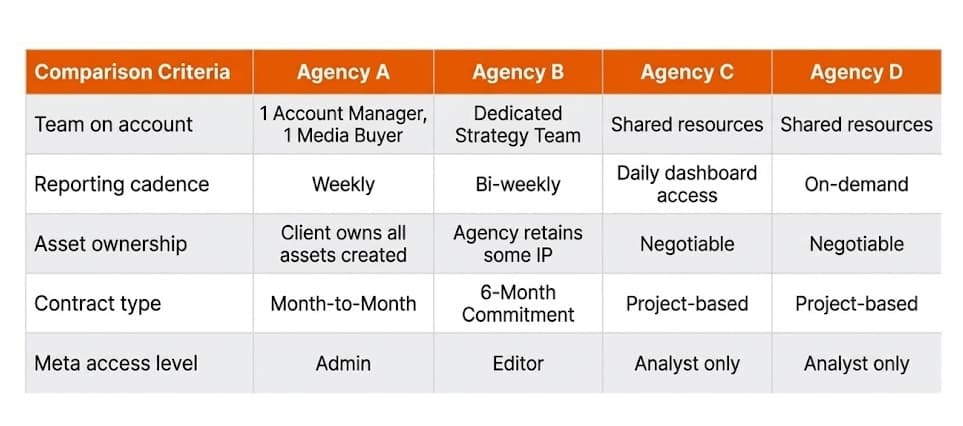
A Comparison Framework That Works
“Top 10 agency” lists don’t help you choose. You need criteria that map to your situation: spend level, what you keep in-house (creative, strategy, reporting), and how much you want to own strategy vs. execution.
| Criterion | Why it matters |
|---|---|
| Who’s on your account | Dedicated strategist + buyer vs. shared pod vs. rotation. Affects consistency and who you escalate to. |
| Reporting cadence and format | Weekly sync + dashboard vs. monthly PDF. You need something you’ll actually use for decisions. |
| Asset ownership | Where ad accounts, pixels, and catalogs live. If you part ways, can you take everything without a fight? |
| Contract terms | Minimum commitment, notice period, fee structure (percentage of spend vs. flat retainer). |
| Meta access model | Business Manager roles, how many people have access, and whether they work inside your BM or a shared agency BM. |
Use this as a scorecard in discovery. If an agency won’t answer clearly on asset ownership or access, treat that as a disqualifier.
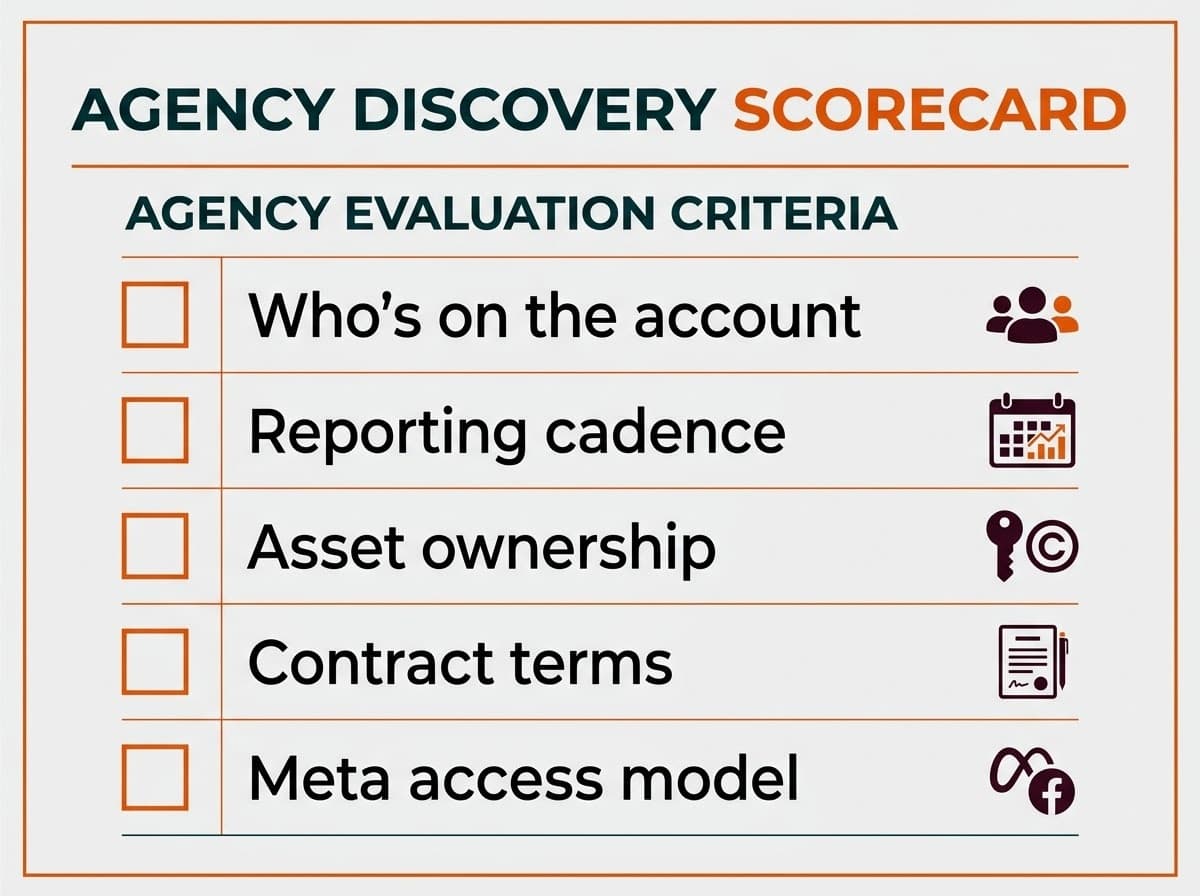
What to Ask in Discovery
- “How many people touch our account, and what are their roles?” You want names and roles, not “a dedicated team.”
- “What level of access do you need in Business Manager, and why?” They should justify Ad Account access, not full Business Manager control, unless there’s a specific reason.
- “Where do our ad accounts and pixel live—in our Business Manager or yours?” Your BM = your assets. Their BM = you’re locked in until you migrate.
- “How do you run creative tests—who briefs, who produces, who approves?” If they can’t describe the workflow, creative quality and speed will be an issue.
Jon Loomer has long emphasized that agency selection is about structure and process, not promises. The agencies that can articulate their access model and creative workflow in detail are the ones that can actually deliver it.
Real-World Example: Structured RFP
One DTC brand ran a structured RFP with five agencies. They sent the same brief and required each to complete the comparison table and answer the discovery questions in writing. Two dropped out when asked about asset ownership. The other three were scored on the same criteria. They hired the one that offered the clearest access model (work inside the brand’s BM, Ad Account Advertiser only) and a 90-day out clause. No surprises on handoff when they later brought creative in-house; the agency had never owned the accounts.
Red Flags
- Vague “we’re full-service” with no clear team or process.
- Refusal to document who has Meta access or to work inside your Business Manager.
- No clear reporting beyond “you’ll get a dashboard” with no cadence or owner.
- Long lock-in and no asset-migration clause.
Actionable Takeaway
Before you sign with a Facebook ads agency: (1) define your scope (in-house vs. outsourced, retainer vs. project), (2) build a comparison table with the criteria above, (3) run discovery with the same questions for every finalist, and (4) insist on asset ownership and clear Meta access in the contract. Use this as a hiring checklist, not a vendor list.
For what to hold an agency accountable for once they’re running campaigns, see scaling-meta-ad-spend and meta-ads-updates-february-2026.
Running Meta in-house and want to keep creative, reporting, and launch in one place? Wonderful helps you create and test ad creatives faster—whether you’re evaluating an agency or running campaigns yourself.