Wonderful Blog
Email Marketing Audit

Published March 9, 2026
Email Marketing Audit
An email marketing audit fails when it becomes a vague “looks good” review or a deep technical project nobody can act on this week.
This post gives you a first-pass audit scorecard and a quick triage workflow so you can find the biggest structural issues first: targeting mismatch, creative underperformance, deliverability risk, automation gaps, and reporting ambiguity. It is scoped to audit execution only (not a full deliverability remediation guide).
TL;DR
- Score the system, not the template. Your audit should cover targeting, creative, deliverability, automation, and reporting.
- Triage with priorities. Quick wins often fix symptom-level problems; structural issues require sequencing and ownership.
- Validate deliverability assumptions. Before you optimize content, confirm your authentication and engagement reality.
- Use the audit output for next actions. End every audit with 3–5 changes, owners, and a review cadence.
For deliverability fundamentals (bulk sender requirements like authentication and list hygiene), see Email sender guidelines (Google Workspace Admin).
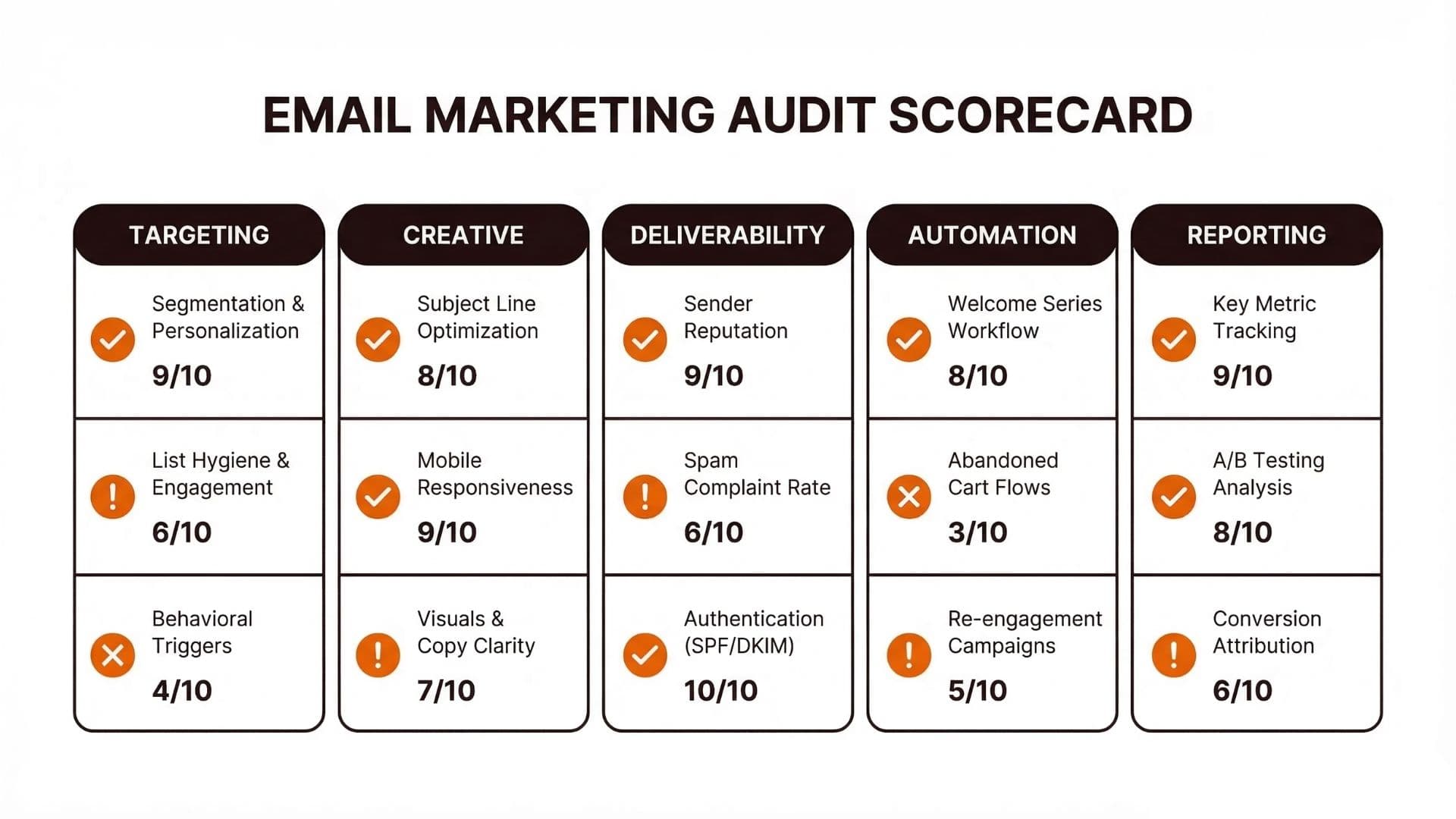
The 5-Part Email Audit Scorecard
Use this scorecard as your “baseline view.” The goal is to identify which category is failing and why.
1) Targeting
- Are segments based on intent and lifecycle stage (not just demographics)?
- Does each segment receive a message that matches its next decision?
- Are you suppressing contacts that should not receive certain campaigns?
2) Creative
- Is subject/body structure consistent with the segment's intent?
- Are you using proof where it matters (not everywhere)?
- Are you removing friction in the CTA (one primary action, clear next step)?
3) Deliverability
- Is authentication configured properly (SPF, DKIM, DMARC)?
- Are you managing list hygiene and suppression?
- Do your engagement signals match what you think people are doing?
4) Automation
- Do your onboarding and post-conversion flows trigger correctly?
- Are you covering “no-action” scenarios (beyond a single reminder)?
- Do automations ladder users into the right next campaign?
5) Reporting
- Can you explain performance in business terms (replies, qualified leads, conversions), not just opens/clicks?
- Is reporting consistent enough that you can compare weeks?
- Do you have enough data quality to trust what you see?
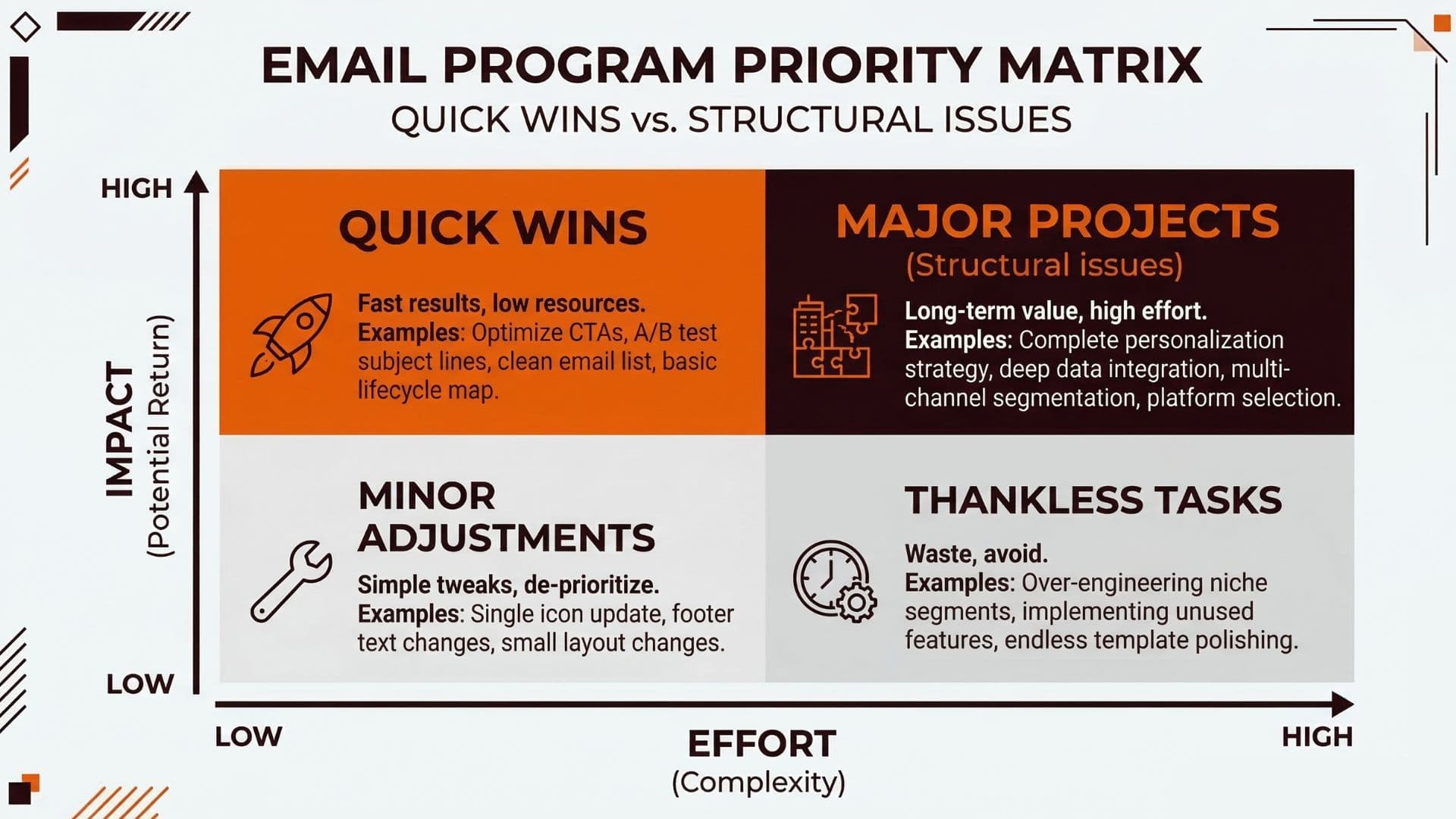
Triage Matrix: Quick Wins vs Structural Fixes
Once you score each category, decide what to do first.
Use this matrix:
- Quick wins: changes you can ship without waiting for engineering or deep stack rewiring.
- Structural issues: problems that require ownership changes, workflow redesign, or deliverability remediation sequencing.
The point of the audit is not documentation. It is prioritization.
“First-Pass” Audit Checklist (What to Review in One Session)
Plan a single review session, then produce next steps.
Use this first-pass checklist:
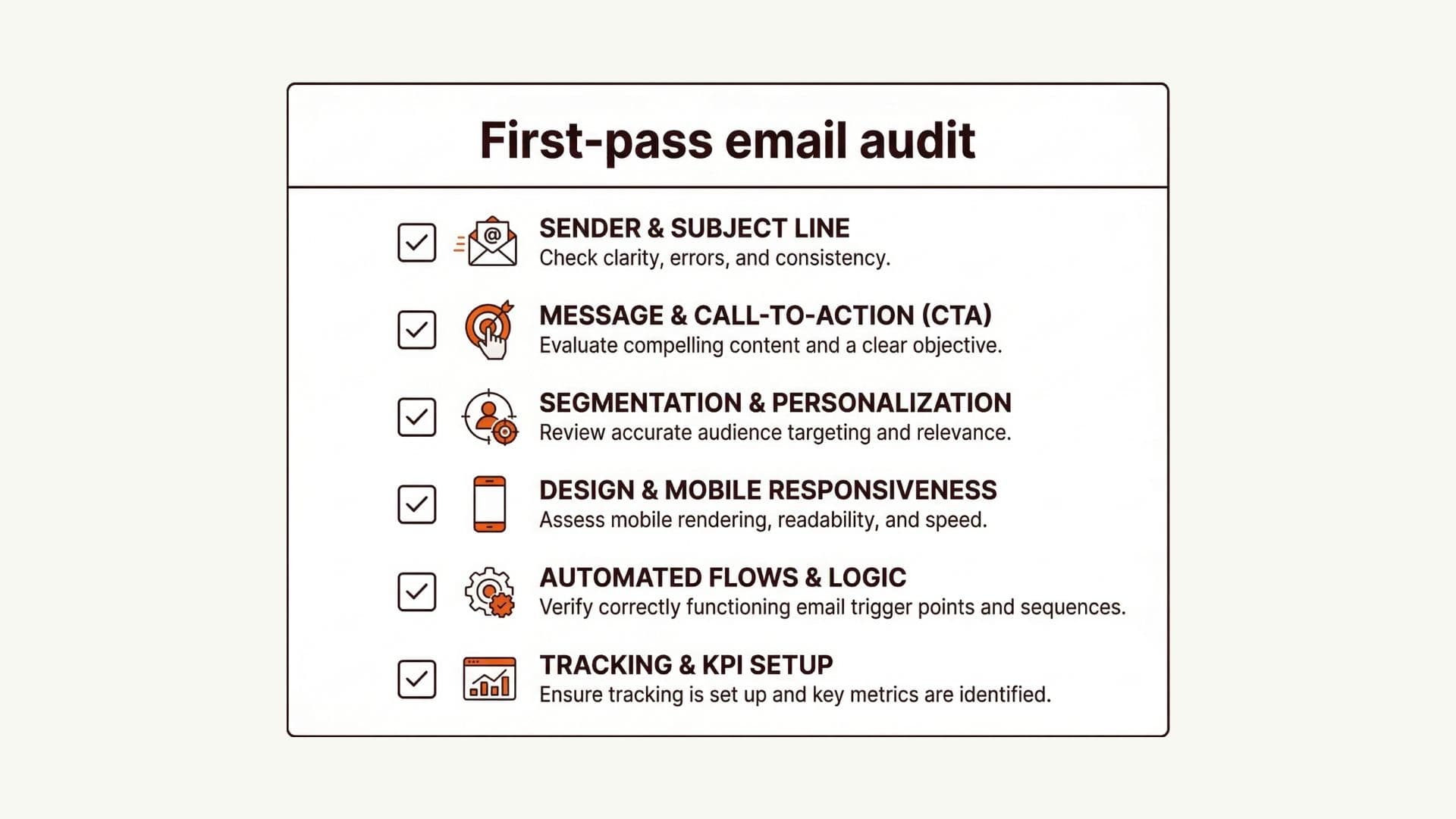
- Confirm your segments map to intent + lifecycle.
- Identify your top 3 campaigns by volume and compare performance across weeks.
- Spot creative mismatches: hook, proof, and CTA alignment by segment.
- Validate deliverability basics and engagement reality.
- Audit automation coverage: onboarding, nurture, and “next step” paths.
- Ensure reporting can explain results and is consistent enough to iterate.
Real-World Outcome: Less Guessing, Faster Fixes
One B2B team ran a first-pass audit before they scaled send volume. The audit found the biggest structural issue was not the newsletter design—it was targeting logic. They fixed segmentation to match the reader's “next decision,” adjusted proof placement, and added a missing automation handoff after demo requests. You can benchmark against real email examples from top brands to see how they structure proof and CTAs. Deliverability stayed stable, engagement improved, and the team stopped interpreting opens as a success metric.
Actionable Takeaway
Run an email marketing audit as a repeatable scorecard:
- Score targeting, creative, deliverability, automation, and reporting.
- Triage with the quick wins vs structural matrix.
- Ship 3–5 changes with owners and a review cadence.
For evergreen deliverability context, start with Email Marketing 2025: Recap and What Still Matters. For targeting strategy and segmentation patterns, see Targeted Email Marketing.
Soft CTA
Wonderful can help you connect email planning, creative production, and approval workflows so your audit outputs turn into shipped changes—not just notes. Use Wonderful's Review & Approvals to review and approve emails with annotation tools. For broader audit context, see Email Marketing 2025: Recap and What Still Matters and Targeted Email Marketing.