Wonderful Blog
Meta's New Customer Lifecycle Strategy: The Ultimate Guide to Pure Acquisition in 2026
How to stop wasting budget on retargeting and force Meta to find net-new customers.

Published March 27, 2026
Meta's New Customer Lifecycle Strategy: The Ultimate Guide to Pure Acquisition in 2026
If you've been running Meta ads for any length of time, you know the struggle. You launch a campaign designed to bring in fresh blood, only to check your dashboard a week later and realize Meta spent half your budget retargeting people who bought from you last month.
Your Return on Ad Spend (ROAS) looks incredible, but your actual business growth? Stagnant.
For years, the workaround was tedious: manually building custom audiences of past purchasers, website visitors, and email subscribers, then meticulously excluding them at the ad set level. It was clunky, prone to error, and required constant updating.
But in early 2026, Meta quietly rolled out a feature that solves this exact problem: the Customer Lifecycle Strategy.
Found at the ad set level, this new feature lets you tell Meta explicitly to only spend your budget acquiring people who have never purchased from you before. No retargeting. No "reach both." Just pure, unadulterated new customer acquisition.
Here is a deep dive into what this feature is, how it works, and how you can leverage it to scale your brand in 2026.
What is Meta's Customer Lifecycle Strategy?
The Customer Lifecycle Strategy is a new setting available at the ad set level for manual Sales campaigns. It is designed to give advertisers granular control over who their budget is spent on, specifically differentiating between prospecting (new customers) and remarketing (existing customers).
Think of it as the manual campaign equivalent to the "Existing Customer Budget Cap" found in Advantage+ Shopping Campaigns (ASC). Instead of relying on manual exclusions, you define your existing customers once at the Ad Account level. Meta then uses that centralized definition to automatically filter out past buyers from any ad set where you've toggled the new customer acquisition setting on.
How Does It Work?
When you navigate to the ad set level in a Sales campaign, you will now see a section labeled Customer lifecycle. Inside, you are presented with two primary options:
| Option | How It Works | Best Use Case |
|---|---|---|
| Reach new and existing customers | Meta optimizes for conversions across everyone, blending prospecting and retargeting. Cost per result is generally lower because it includes easy wins (past buyers). | General scaling, maximizing total revenue, and campaigns where you don't mind repeat purchases. |
| Acquire new customers only | Meta explicitly excludes your defined existing customers and focuses 100% of the budget on net-new acquisition. | Aggressive growth phases, expanding market share, and strict prospecting campaigns. |
Additionally, early access users have noted that the feature also allows you to exclude "engaged audiences" or "brand aware" users, ensuring your budget is spent entirely on cold traffic.
Meta is transparent about the trade-off: if you choose "Acquire new customers only," your Cost Per Action (CPA) will likely be higher on paper. However, every single conversion you get is a brand new customer adding incremental value to your business, rather than a repeat buyer who might have purchased anyway.
Why This is a Game-Changer in 2026
To understand why this matters, you have to look at the broader context of Meta's advertising ecosystem in 2026.
With the rollout of Meta's highly advanced Andromeda algorithm, the platform has shifted heavily toward broad targeting. The AI is incredibly smart—often too smart. Because the algorithm's primary goal is to get you the cheapest conversion possible, it naturally gravitates toward the path of least resistance: people who already know, like, and trust your brand.
This creates the "Breakdown Effect" illusion. Your dashboard looks incredibly healthy, but your blended Customer Acquisition Cost (CAC) is actually rising because you aren't feeding the top of your funnel.
The Customer Lifecycle Strategy feature forces the algorithm to do the hard work. By natively locking out existing customers, you prevent Meta from taking the easy way out. You no longer have to worry about whether your custom audience exclusions are up to date or if the pixel missed a recent buyer. Meta handles the exclusion logic natively and account-wide.
Early Results: Is It Worth It?
The early data from media buyers who got beta access to this feature is incredibly promising.
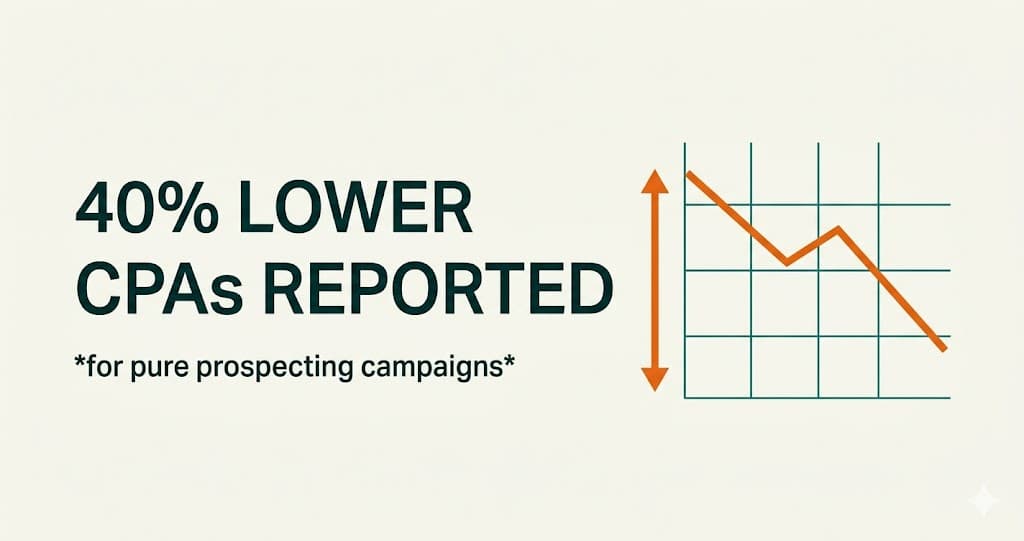
According to early reports from DTC marketers, campaigns utilizing the "Acquire new customers only" setting are seeing massive efficiency gains. One media buyer reported that their CPAs were approximately 40% lower than their traditional prospecting campaigns, with exactly 0% of the spend hitting existing customers.
While Meta warns that costs could be higher when excluding past buyers, the reality is that when you force the algorithm to optimize purely for cold traffic, it gets better at finding high-intent new buyers.
How to Get the Most Leverage Out of It in 2026
If you want to maximize this feature, you can't just flip the switch and walk away. Here is how to build a strategy around it:
1. Define Your Customers Accurately
The entire feature relies on your Ad Account Settings. Make sure you have comprehensively defined your "Existing Customers" using a combination of your Meta Pixel purchase events, Conversions API data, and an uploaded, auto-syncing CSV of your customer lifetime value (LTV) list. If your definition is flawed, the feature won't work.
2. Align Your Creative with the Funnel
If you are telling Meta to only target new customers, your creative must speak to an "Unaware" or "Problem Aware" audience. Stop using bottom-of-funnel discount codes or highly technical product specs. Instead, focus on:
- Educational hooks: Explain the problem your product solves.
- Founder stories: Build trust from scratch.
- Broad appeal: Use dynamic, native-looking creative (like founder selfies or raw short-form video) that stops the scroll for someone who has never heard of you.
3. Measure What Matters (Ignore the Blended ROAS)
When you run a pure acquisition campaign, your in-platform ROAS will drop. Do not panic. You are no longer subsidizing your metrics with cheap retargeting conversions. Instead of looking at ROAS, measure the success of these ad sets by looking at your Marketing Efficiency Ratio (MER) and your New Customer Acquisition Cost (nCAC) at the business level.
4. Use It to Test True Creative Winners
In the past, a piece of creative might look like a winner simply because it resonated with your warm audience. By using the "Acquire new customers only" setting, you create a sterile testing environment. If an ad can profitably convert cold traffic under this setting, you know you have a scalable, winning asset.
Conclusion
Meta's new Customer Lifecycle Strategy is the exact tool e-commerce and DTC brands have been begging for. By removing the friction of manual exclusions and forcing the algorithm to hunt for net-new growth, Meta is giving advertisers the power to scale predictably in 2026.
Check your Ads Manager—the feature is rolling out at the ad set level right now. Set your customer definitions, align your creative for cold traffic, and watch your true customer base grow.